

Cubic metres are the starting point, but they are not enough on their own. To choose the right salt chlorinator, you need to relate the volume of the swimming pool to the output in g/h, operating hours and actual conditions of use.
The quick answer
To choose a salt chlorinator based on the volume of your swimming pool in m³, start by identifying the models whose The recommended range includes your volume. It then compares its output in g/h, check how many the actual number of hours he will be able to work the team and copes well with the most demanding summer conditions.
Rule of thumb: If your swimming pool is close to the recommended upper limit for a particular model and is also exposed to a lot of sun, has warm water or is subject to heavy use, do not automatically opt for the minimum specification. Compare the next higher capacity model or check the available filtration time.
1. First, work out the volume of the swimming pool in m³
Volume is the first piece of data we need because it allows us to narrow down the range of chlorinators we need to study.
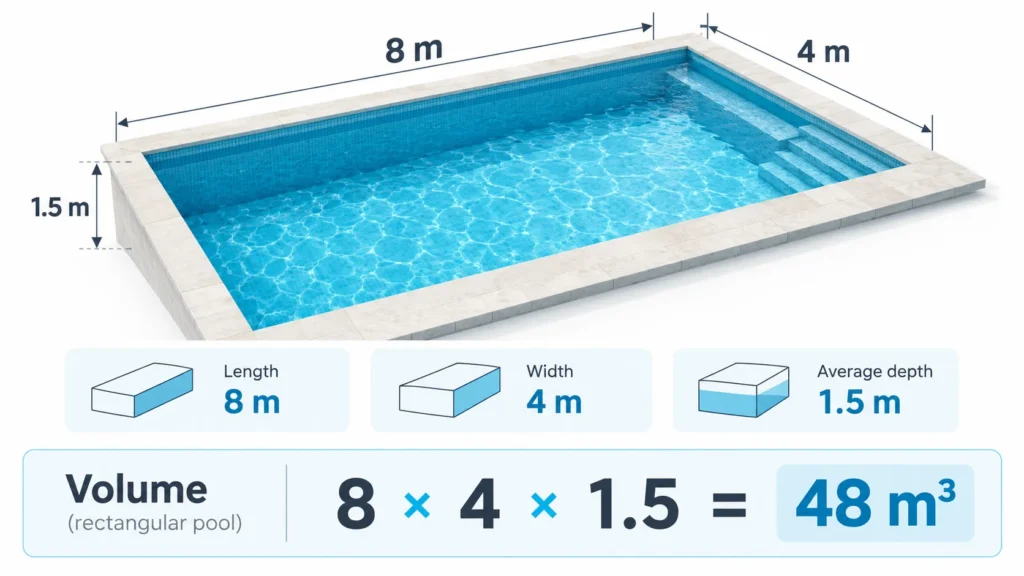
In a rectangular swimming pool:
Length × width × average depth = m³
For example:
8 × 4 × 1.5 = 48 m³
A swimming pool 8 metres long, 4 metres wide and with an average depth of 1.5 metres has approximately 48 m³.
If the swimming pool has varying depths, use a reasonable average depth. For irregularly shaped pools, with submerged areas or special features, it is best to calculate the volume in sections.
What you need to remember: Cubic metres are a good starting point for narrowing down your choices, but they do not, on their own, determine which chlorinator you need.
2. Compare the chlorinator’s output in g/h
The capacity of a salt-based chlorinator is normally expressed in grams of chlorine per hour (g/h). This figure allows for a comparison of the maximum production capacity between models.
A team of 20 g/h It can theoretically produce up to 20 grams in one hour of operation at maximum output.
| Fact | What does it mean? | What is it for? |
|---|---|---|
| m³ | Volume of water | Narrow down the models that might be suitable |
| g/h | Chlorine production per hour | Compare production capacity |
| g/L | Salt concentration in water | Check the salinity range required by the equipment |
Don’t confuse g/h with g/L
20 g/h refers to the chlorinator’s production capacity.
An indication such as 3–4 g/L It refers to the concentration of dissolved salt in water.
These are two different pieces of information.
Nor is there a universal rule such as:
50 m³ = always X g/h
The manufacturer’s specifications state the range for each model, and you then need to consider how the pool will actually be used.

Examples from the Trypool range
TRYCLOR v2
Adjustable output up to 20 g/h and adjustable volume settings within the range published by Trypool.
Aquark Ares Premium
Available in batches of 16, 22 and 28 g/h, with pH, Redox/RX and Wi-Fi functions in the Premium version.
Crystal Aquark
Range with production figures of 16 to 36 g/h and different models for different pool volumes, up to 130 m³ according to the published model.
These examples help to explain why two chlorinators designed for domestic swimming pools can have different production capacities.
3. Check how many hours you will actually be able to work
The chlorinator requires water circulation to operate. That is why we must link the unit’s output to the length of time it will actually be able to operate.
The basic relationship is:
Theoretical maximum output = nominal g/h × actual operating hours
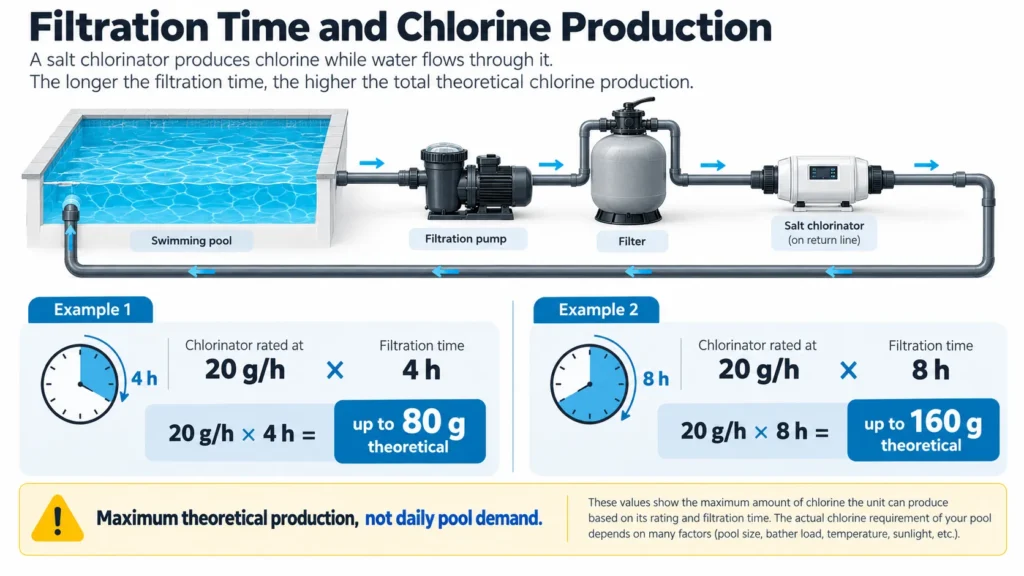
For example, with a 20 g/h chlorinator operating at maximum capacity:
- 4 hours’ operation → up to 80 g (theoretical).
- 8 hours’ operation → up to 160 g (theoretical).
This does not mean that a swimming pool necessarily needs 80 or 160 grams of chlorine a day.
The formula only allows us to determine the theoretical maximum available capacity during that time.
If the equipment is set below its maximum output, the amount actually generated will be lower.
That is why it makes no sense to compare only the g/h without also knowing the number of hours available for production.
If you also need to review the relationship between the pump, filter and flow rate, it is advisable to analyse the sizing of the filtration system beforehand.
4. Think about the busiest days at the swimming pool
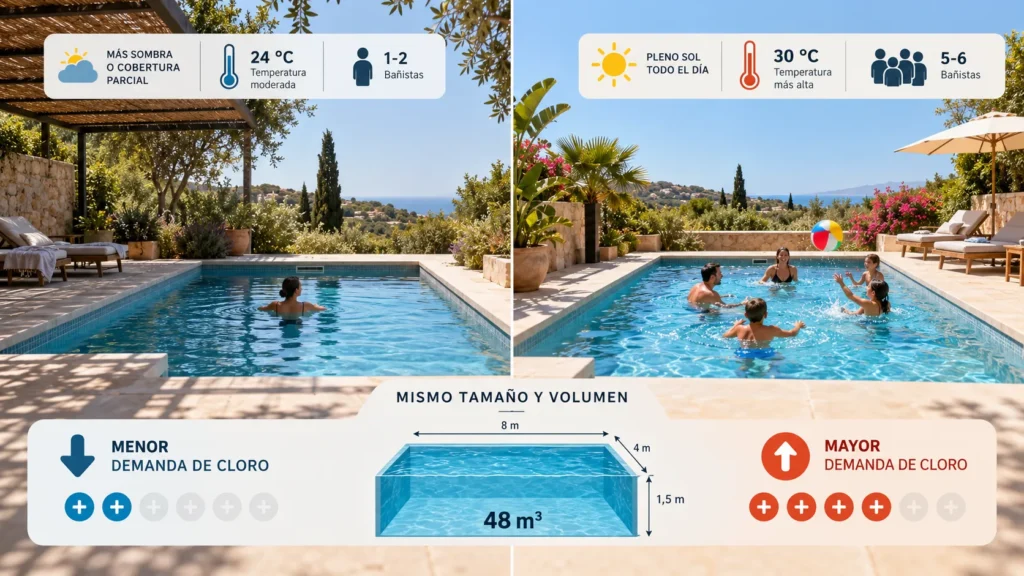
Two swimming pools with exactly the same volume in m³ may have different requirements.
To make a well-informed choice, it is worth giving particular consideration to summer conditions, when the installation is normally operating under the most demanding conditions.
Temperature
Hotter water and a period of heavy use can place greater demands on the treatment system.
Sun and deck
Many hours of direct sunlight and an outdoor swimming pool can increase the demand for disinfectant.
An indoor swimming pool that is only used part of the time may operate under different conditions to one that is entirely exposed to the elements.
Bathers
A swimming pool that is used only occasionally does not bear the same load as one that is used daily by several people.
That is why volume is important, but it does not, on its own, explain everything that happens in the swimming pool.
If you are close to the boundary of a model, compare the next stage of production or check whether the filtration schedule allows for sufficient operating time.
The manufacturer’s table is the starting point; actual conditions help to determine the margin.
I have a swimming pool with a volume of X m³: what should I do next?
The following ranges do not constitute a universal sizing table.
They help us to understand how the selection changes as the volume increases and what you should check before choosing a particular model.
Up to 30 m³: small swimming pools
Start with domestic models whose recommended range covers your volume.
With small swimming pools, it’s relatively easy to oversize the system, so don’t automatically choose much larger equipment simply “just in case”.
Temperature remains an important factor: the same chlorinator may have a different approximate volume depending on the operating conditions.
Around 50 m³: compare in more detail
This volume may contain several models with different production runs.
Don’t just take my word for it:
“Suitable for 50 m³”.
See also:
- output in g/h;
- hours of filtration available;
- sun exposure;
- temperature;
- use of the swimming pool;
- close to the model’s recommended limit.
A 50 m³ indoor swimming pool that is rarely used does not require the same maintenance as a 50 m³ pool that is in full sun and used every day.
Between 70 and 90 m³: allow for a margin when conditions are challenging
When the volume approaches a model’s recommended maximum, summer conditions become even more important.
Please take particular note of:
- temperature;
- sun exposure;
- number of bathers;
- actual production time.
If the candidate team comes very close to its limit, also compare the next production tier before finalising the selection.
Between 100 and 130 m³: look for ranges designed for large volumes
When dealing with these volumes, it is advisable to work with ranges that include higher-volume models and whose manufacturer specifically caters for large swimming pools.
At Trypool, for example, the Crystal range is available for different pool volumes, up to 130 m³ depending on the model.
Furthermore, in the case of a communal swimming pool, a hotel swimming pool or one with a high number of bathers, the design must be considered as a specific installation, and the criteria for a conventional residential swimming pool should not be directly extrapolated.
An example that shows why cubic metres aren’t enough
The Innowater SMC10 produces 10 g/h.
The manufacturer specifies different volume values depending on the water temperature: up to approximately 30 m³ at temperatures below 25 °C and even 20 m³ at temperatures above 25 °C.
In other words:
same chlorinator + same nominal output + different temperature = different approximate volume.
This example helps to explain why there is no single valid conversion between m³ and g/h.
Conclusion: Use the m³ to draw up an initial list of compatible models. Then let the g/h, the available hours and the actual conditions of use determine which one offers the right margin.
5. Decide how much you want to automate
Once the production capacity has been determined, we can assess other functions.
Automation It is no substitute for proper sizing. It adds control and convenience to a well-designed installation.
| Need | What to consider | What it offers |
|---|---|---|
| Disinfection | Adjustable salt-based chlorination | Automated production of disinfectant |
| Fewer manual adjustments | pH control | Helps to maintain the pH within the set point |
| Advanced control | pH + Redox/ORP | It allows for greater automation of the process once the system has been correctly configured |
| Remote monitoring | Wi-Fi / app | Access to the remote functions available on each model |
Redox is not the same as ppm of chlorine
The ORP or Redox measures the oxidising potential of water.
It is not a direct reading of free chlorine expressed in ppm and should be interpreted in conjunction with the other treatment parameters.
So, which salt chlorinator do I need?

You can summarise the whole process in seven steps.
1. Work out the volume
Calculate the actual volume of the swimming pool in m³ and exclude any models whose recommended range does not include that volume.
2. Compare production
Compare the g/h of the shortlisted models.
3. Check how much time you have
Check how many actual hours the team will have available for production.
4. Assess the pool’s requirements
Pay particular attention to heat, exposure to the sun, the roof and use during the summer.
5. Decide how much margin you need
If you are close to the equipment’s recommended limit and conditions are demanding, consider the next production tier.
6. Choose the level of automation
Next, decide whether you only need salt chlorination or whether you also need pH and redox control, as well as Wi-Fi connectivity.
7. Check the manufacturer’s terms and conditions
Before completing the installation, check the following:
- required salinity;
- flow rate;
- hydraulic conditions;
- production;
- installation requirements;
- the conditions set out in the technical data sheet and the manual.
Example: two swimming pools of 48 m³ may require a different approach
The two swimming pools in this example measure:
8 × 4 × 1.5 m = approximately 48 m³
The volume is exactly the same.
However, the conditions do not.
Pool A: moderate use
Indoor swimming pool (covered part of the time), normal family use, controlled temperature and sufficient filtration hours.
How to choose: Find the models whose capacity is approximately 48 m³ and compare their output in g/h with the time available for production.
Pool B: heavy use
A swimming pool exposed to the sun for many hours, high water temperature, frequent use and limited filtration time.
How to choose: For compatible models, consider increasing the production margin or check the filtration schedule first.
This example does not mean that a 48 m³ swimming pool always requires a particular model.
It serves to show why Volume is only one part of the decision.
What information do you need before making a choice?
Before comparing chlorinators, it is worth knowing:
- approximate volume of the swimming pool in m³;
- expected filtration hours;
- typical summer temperature;
- sun exposure;
- whether or not there is a roof;
- regular use and peak numbers of bathers;
- nominal chlorine generator output in g/h;
- the operating salinity required by the equipment;
- flow rate and hydraulic conditions;
- if automatic pH control is required;
- if Redox control is required;
- stabiliser/CYA and water balance where applicable.
Once the equipment has been installed, the final settings must be checked by carrying out an actual water analysis.
Proper initial sizing is no substitute for monitoring:
- free chlorine;
- pH;
- salinity;
- cell state;
- traffic;
- the actual performance of the installation.
Common mistakes when choosing a salt-based chlorinator
Buy only up to “X m³”
The volume figure helps to narrow down the selection, but it should not, on its own, determine the final decision.
Confusing g/h with g/L
The g/h indicate the team’s output.
The g/L indicate the salt concentration in the water.
Ignore the operating hours
Without water circulation, the equipment does not have the same effective production time.
Always choose the largest set
Greater capacity is no substitute for proper sizing or adequate regulation.
Add more salt to make more
The salt level must be kept within the range specified by the equipment manufacturer.
To think that any lack of chlorine means the chlorinator is too small
Before changing the equipment, it is advisable to check:
- pH;
- salinity;
- cell state;
- traffic;
- programming;
- water balance.
Frequently asked questions
What sort of chlorinator do I need for a 50 m³ swimming pool?
Start with the models whose recommended range includes 50 m³. Then compare g/h, operating hours and summer conditions.
If you are close to a model’s limit and the pool is exposed to a lot of sun or is subject to heavy use, it is worth considering a higher production margin.
Is more g/h always better?
Not necessarily.
You need sufficient capacity and a reasonable margin, but you also need appropriate regulation. Oversizing for no good reason does not automatically make the installation any better.
Do g/h and g/L mean the same thing?
No.
The g/h indicate how much chlorine the unit can produce per hour.
g/L indicates the concentration of dissolved salt in water.
Can I choose the chlorinator based on m³ alone?
Cubic metres provide a basis for an initial selection, but before confirming a model, it is advisable to check production capacity, available hours, temperature, sun exposure and intended use.
What happens if my swimming pool is exactly at the maximum recommended volume for the chlorinator?
It does not automatically mean that the equipment is inadequate.
However, it is worth paying particular attention to summer conditions. If it is very hot, sunny, there are many bathers, or filtration time is limited, it may be worth considering the next level of production.
How many hours should the chlorinator run for?
There is no single figure that applies to everyone.
It depends on the filtration system, the equipment’s capacity, its settings and the pool’s requirements. It must be coordinated with the system’s operating times and conditions.
Do I need automatic pH control?
It is not essential in all installations, but it can reduce the need for manual adjustments and help maintain a more stable treatment process if it is correctly installed, configured and maintained.
Does the redox test replace the chlorine test?
No.
ORP/redox and free chlorine are different parameters. An automatic system must be accompanied by regular water tests and probe maintenance.
In summary
To choose a salt chlorinator based on the volume of your swimming pool in m³, follow these steps:
m³ → g/h → available hours → conditions of use → margin → automation
The m³ enable you to identify which devices may be compatible.
The g/h enable a comparison of their production capacity.
The available hours indicate how long the equipment can operate.
And the actual conditions at the swimming pool determine how much margin it is advisable to leave.
This way, you avoid two common mistakes: under-specifying the system when the pool places the greatest demands on it, or installing a larger system than necessary without a technical reason.
The final choice should always be checked against the technical specifications and the user manual for the specific model.


 Español
 English (UK)
 Français
 Português